Woven Wood Shades Throughout Danville
Natural weave for streets with century old canopy
Read these before you choose a fabric. Material, mount and lift decisions constrain what fabrics make sense, and working in that order avoids falling for something that won't work in the room.
- Service: Woven Wood Shades for Danville homeowners
- Service area: Danville, IN and surrounding areas The measure gets scheduled quickly. The build does not, because your fabric or shutter panel is cut to your numbers after you order. Two to five weeks is normal. Service calls skip that step entirely.
- Insured and bonded
- Serving Danville, IN since 2008
Expert Woven Wood Shades for Danville Homes
Woven wood belongs on Danville's oldest and shadiest streets. The Main Street Historic District and the blocks around the courthouse carry street trees planted alongside houses built between 1844 and 1920, a canopy roughly a century old, and that filtered green light is exactly what a bamboo or reed weave does something interesting with. A Craftsman bungalow from the 1900 to 1925 range runs 12 to 18 openings with wide banded groupings and broad eaves, and a natural weave sits beside that woodwork better than any manufactured material. Ellis Park and the Danville Public Library sit in the same district, so the whole setting is mature planting rather than open ground.
Natural material means natural variation, and you have to be willing to accept it. Reed and bamboo differ in tone from stalk to stalk and from harvest to harvest, so two shades from the same order will not be identical and one ordered next year may sit noticeably apart. That is the character of the product, not a defect, and no fabricator will replace a shade over it. A bare weave also passes light freely and gives you no privacy at all after dark, so a bedroom or a street facing room on North Wayne needs a liner, which adds thickness and deepens the stack.
Signs You Need Woven Wood Shades
If you notice any of these in your Danville home, it is worth booking a measure. None of it is urgent, and none of it fixes itself either.
A room reads cold with nothing but hard surfaces
Blinds look flat against wood and stone
A wide natural shade sags in the middle
Bare windows on a sunroom or a porch
A shade over the sink has warped from water
Existing naturals have lightened unevenly in sun
Strings on an old shade have started breaking
A neighbor looks straight into a lit room
Bedroom light still comes in around the edges
Aluminum blinds feel wrong in a warm room
How Danville Window Treatments Handles Woven Wood Shades
Every job follows the same five-step process. Transparent, thorough, and done right the first time.
Samples left in your daylight
Mounting depth and stack figured
Weave and fiber chosen
Liner decided and written down
Material run confirmed at ordering
Woven Wood Shades in Danville
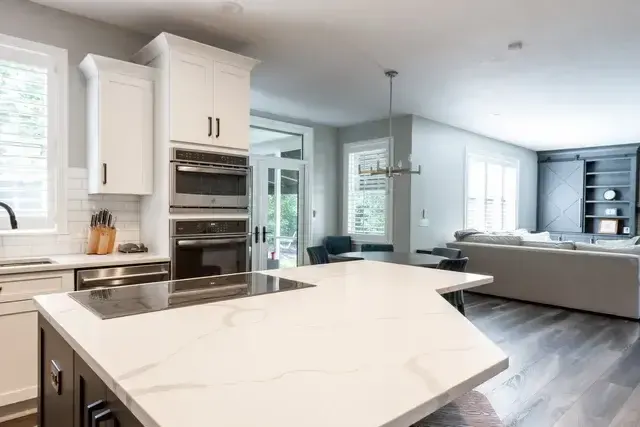
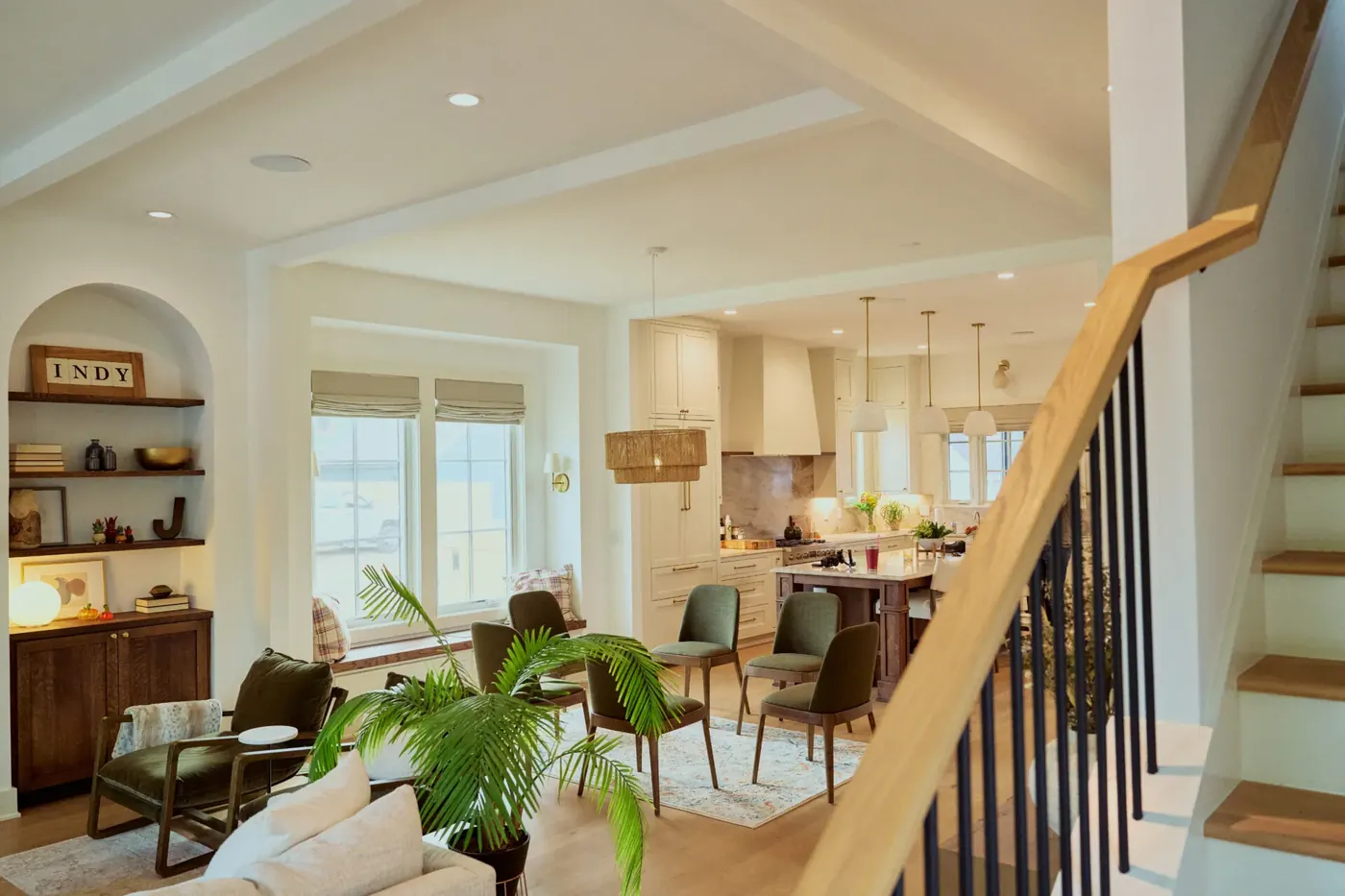
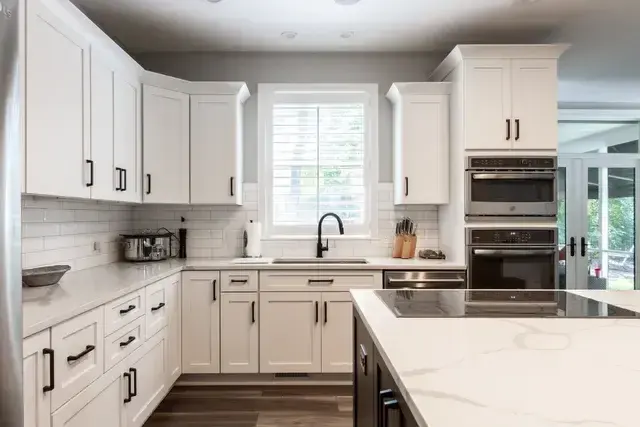
Photographs from real woven wood shades jobs completed by our crew in Danville and surrounding areas.
What Woven Wood Shades Includes
Every Danville job is documented item by item. Here is what the crew covers.
Three widths and three heights at every opening plus a diagonal check, because a natural weave shows an out-of-level hem plainly
Inside-mount depth checked against the bundled material, which needs more room than a rolled fabric does
Stack height figured against the actual weave, since a natural material bundles much deeper than a roller of the same size
Material chosen by weave and fiber: split bamboo, flat reed, jute, grasses or a mixed weave with wood
Samples left in your own daylight for a day, because these read nothing like they do under a showroom bulb
Privacy liner decided window by window, light filtering or room darkening or none, and written on the order
The liner's effect on the look shown with a sample held behind the weave before you commit to it
Edge banding specified anywhere a cut edge would ravel or read unfinished against painted trim
Valance style and depth chosen so the headrail is actually covered rather than half hidden
Top-down bottom-up specified where a room wants daylight up high and cover down low
Lift specified as cordless, a cord loop with a tensioner, or a motor sized to a heavy lined natural
ANSI/WCMA A100.1-2022 cord safety applied per opening, and cordless specified in any room a child uses
Natural variation between the hand sample and the production run explained before the order goes in, not after it arrives
Every shade for one room ordered on the same purchase so the material comes off the same run
Openings over a cooktop or inside the spray of a shower identified and moved to a different product
Extension brackets specified where a shallow opening won't take an inside mount cleanly
Headrail brackets landed in framing, since a wide natural with a liner is heavier than it looks
Folds dressed and the shade cycled on install day so the material learns to stack evenly
What Woven Wood Shades Cost in Danville
National category figures run about $60 to $600 per window for stock shades and about $250 to $2,600 per window for custom-fabricated ones. Read those as national ranges for a category rather than a price for a house in Danville. Naturals sit across a surprisingly wide part of that band. A basic split bamboo on a small opening is near the bottom. A hand-woven grass with a room darkening liner, edge banding and a waterfall valance on a tall window is a different animal. The liner is the single biggest add most people don't budget for, and it roughly changes what you're buying. Danville Window Treatments prices from measured openings in Hendricks County, with the liner decision made before the number is written, not bolted on afterward.
How Woven Wood Shades Differ by Product
Every product in this trade behaves differently in a room. Here is what that means for this work.
Split bamboo: Round or halved bamboo canes woven with cotton or jute string. It's the most familiar natural look, it hangs with a strong horizontal line, and the gaps between canes are exactly where light and sightlines get through at night.
Flat reed: Flattened reed woven tight, giving a smoother face and a finer scale than round bamboo. It reads more refined in a formal room, and because the weave packs closer it holds back a little more daylight on its own.
Jute and grass weaves: Softer fibers with visible slubs and color shifts running through the material. This is where the texture argument gets won, and it's also where variation between one shade and the next is most obvious. That variation is the material, not a fault.
Mixed weave with wood: Thin wood slats woven in among reed or grass, adding a stiffer horizontal element and usually a second color. It bridges the gap between a natural shade and a wood blind, and it stacks a bit tighter than an all-grass weave.
Light filtering privacy liner: A fabric backing sewn behind the weave that blocks sightlines while letting a soft glow through. It's what makes a natural shade usable in a bedroom, and it hides the weave from inside the room when the shade is down.
Room darkening liner: A denser backing for bedrooms that need real darkness through the material. It adds weight and stack depth, and it stops the woven texture reading from inside entirely, so you get the look from the street and a flat panel from the sofa.
Edge banding: A cloth or matching-material tape finishing the cut sides of the shade. It stops a raw woven edge from raveling, and on a shade sized down from stock width it's the difference between looking made and looking cut.
Waterfall valance: The material carries up and over the headrail in one continuous piece instead of a separate flat panel. It hides the hardware without introducing a second horizontal line, which matters on a shade whose whole appeal is texture.
Top-down bottom-up: Two lift systems on one shade let you drop the top for daylight or raise the bottom for cover. On a street-facing room it gives you light at the ceiling and privacy at eye level without choosing between them.
Cordless lift: You raise and lower the shade by the bottom rail with nothing hanging beside the window. On a heavy natural with a liner the mechanism has to be sized for the real weight, so we specify the liner before the lift, not afterward.
See What Each Fabric Does To The Light
Pick a fabric below and the window updates. It's a drawing rather than a photograph, so read it as a rough guide to what each family does in a Danville room, and to what it doesn't do.
Openness factor is a measured fabric spec, so you can compare it line to line. The category names are not measured. One maker's room darkening can behave like another maker's light filtering, which is why the sample books come to the measure and get opened in the room they're going in, at the hour that room has the problem.
Woven Wood Shades FAQ
Questions we hear most often from Danville homeowners considering woven wood shades.
Woven Wood Shades Across Danville
We measure and install in every one of these Danville neighborhoods. Each has its own page with the build eras, window conditions and mounting notes for that section.
- Woven Wood Shades in Danville Courthouse Square Historic District
- Woven Wood Shades in Danville Main Street Historic District
- Woven Wood Shades in Orchard Estates
- Woven Wood Shades in Northwood Haven
- Woven Wood Shades in Miles Farm
- Woven Wood Shades in Kensington Venture
- Woven Wood Shades in Whisperwood Lakes
- Woven Wood Shades in Four Oaks
- Woven Wood Shades in Quail West
Other Window Treatment Services in Danville
Danville Window Treatments handles the full scope of window treatment work. Explore our other services below.
Schedule Your Free In-Home Measure in Danville
Reach Us Directly
Our team prioritizes scheduled measures and service calls, and books in-home measures during business hours.
Ready to Book Your Measure?
Call us to set up an in-home measure, or to ask about a treatment that has stopped working. We will talk it through on the phone first.